The five swanlings continue to thrive. At 3 - 3/1/2 months old they are about 2/3 the size of their parents. The feed on this occasion consisted of handfuls of clover which satisfied the swanlings, though the parents were on the lookout for Bakers Delight treats.
And some bonus pictures.
Pretty exciting to have a Baillon's Crake show up at the local pond! I've never seen one before today. The pictures are from this morning. The crake was still loitering in the same patch in the late afternoon when I walked by again. It's chosen a fairly public reed bed right now, next to swan feeding centrale. I hope it finds a quieter section of reeds and decides to stick around.
Swanlings at three months spend a lot of time sitting at the edge of the reeds. Their camouflage is a real advantage at this age, while they are still vulnerable.
The local pond provides an opportune port of call for many birds passing through this area. This morning three ibis popped in for a while. They are really quite cute in the wild. The white ibis that live in city parks will snitch your sushi 'n fries, without a second glance. Consider yourself warned.
What kind of person brings a House Sparrow all the way to Australia in the 1860s? That's late in terms of settlement. Europeans had been headed here for about 80 years by then so it wasn't as if sending sparrows was a high priority. And sparrows couldn't have stowed away like rats and cockroaches. Someone had to keep them alive for months, aboard a ship. Someone really cared. Someone really wanted sparrows in Australia. And clearly that someone hadn't factored all the fab birds already here, that make for way better birdwatching. What kind of thinking is this?

Much to the embarrassment of my husband, I photographed this sparrow at the Farmers Markets on the weekend and decided the local Farmers Markets are now within my Majura Range. It's a destination I walk to regularly so why not? Chatting to the cherry sellers I asked about their season. Light, they said, because of rain. What about native birds attacking the crop? I asked casually. Yes big problem. We can't do anything about them, and sparrows too.
SPARROWS!
Reference for dating entry of sparrows to Oz,
It's not safe to go jogging in my neighbourhood without a
camera. There is always something to see. Fortunately for me, my camera
is tiny enough to carry. Unfortunately for bird
photography, my camera has reached its limits. Increasingly I am finding myself right bird-time, right bird-place, wrong bird-camera, athough the low light this morning didn't help. I am looking into a camera
solution but that's another story.
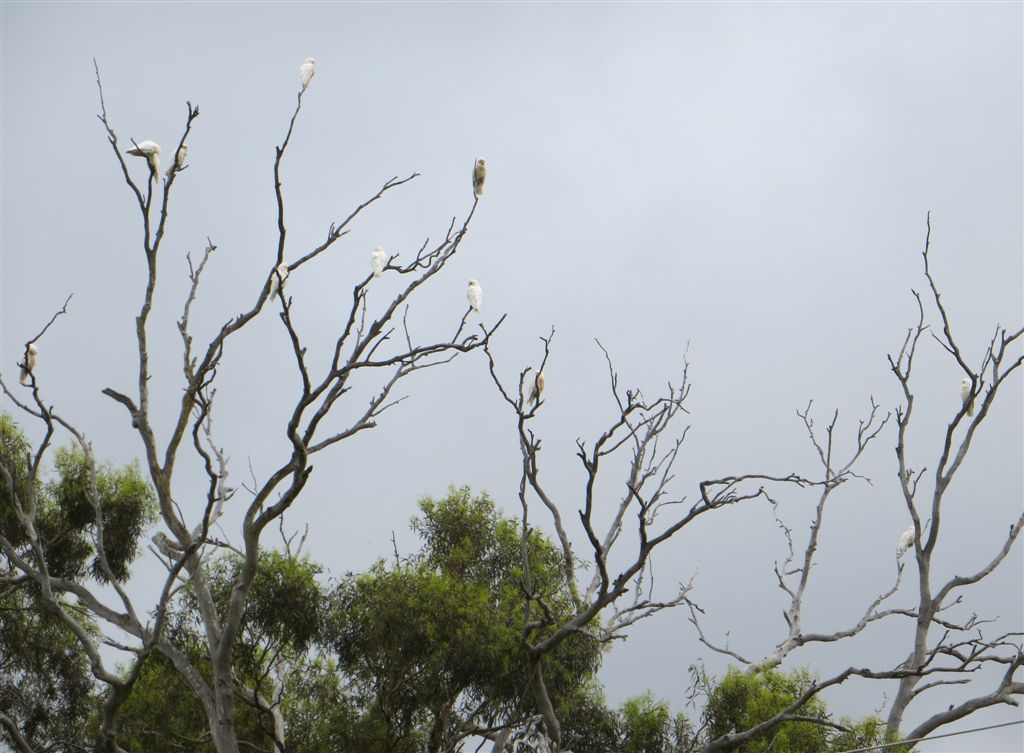
So these Little Corellas added some x factor to the morning.
What a great sight, to look up and see so many.
And so calm! The last corellas I saw were edgy.
Anyhow the plot thickens. Just a few minutes earlier I'd seen what I thought was a flock of
Sulphur-crested Cockatoos. I assumed they were cockatoos because we have plenty around here and from below they looked like
cockatoos and also because they sounded like cockatoos, (if slightly less
corrosive) and also because I was attempting to jog and wasn't imagining corellas. In retrospect I'm wondering if that flock were actually corellas and these are some of them.
This is a washed out photograph (it was misty y'know!) but I'm posting it to show how filthy this corella is. I'll be betting a farmer somewhere in the Murray Darling Basin is mad as a hatter at these birds.
This morning was the the first time I've noticed a Little Black Cormorant at the pond. It's amazing how many birds take turns to sit on that chunk of tree. The designer who came up with the idea of tossing old trees into ponds, really knows what birds like.
Walking home by the pond the other afternoon, I was excited to see a second long-necked turtle, smaller than the one I have previously posted about.
When lo, the turtle I've seen previously also emerged from the murky depths.
Two turtles was too close for comfort for the black ducks. It was time to find a less cramped location.
Just how do these turtles find the pond?
I can't believe it's taken this long to see a Willie Wagtail in my area. I honestly expected to see them everywhere. However a pair were out and about on the weekend. Sure there are plenty of Willie Wagtails in other parts of Canberra, so what's going on here?
 |
| Willie Wagtail |